
As a music professor, I have unique opportunities to create music with students. I am blessed to work at an institution where I have been allowed to push innovation and emerging ideas into the music department.
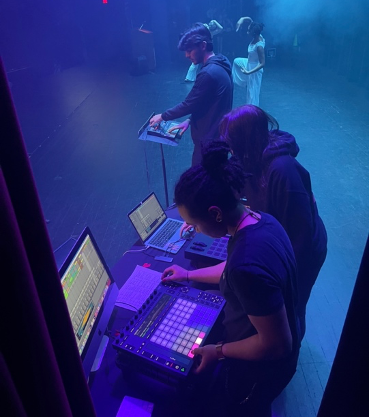
This year, I coached and performed music with a group of students who performed using electronic instruments, including iPads, computers, MIDI controllers, and other electronic devices. [Photo below shows the digital controller ensemble performing live at UNCW’s Kenan auditorium.]
This year, students wrote a song about a personal issue, something close to their hearts that they struggled with daily. It is called imposter syndrome, which is defined as:
A psychological occurrence in which an individual doubts their skills, talents, or accomplishments and has a persistent internalized fear of being exposed as a fraud. Individuals with imposter syndrome often have corresponding mental health issues, which may be treated with psychological interventions, though the phenomenon is not a formal mental disorder.[1]
As we wrote music about imposter syndrome, we had many opportunities to discuss the implications of living with fear, doubt, and anxiety. Tackling imposter syndrome with my students really impacted me personally, as well. It forced me to reflect on who God created me to be, my purpose in higher education, and, most importantly, where I find my identity.
What I realized through writing the song is that I often struggle with doubt, fear, and anxiety, just like my students. I often seek to prove myself to others through my professional career and sometimes worry that I might not ‘add up’ to the accomplishments of my peers.
It made me think about why I am so tired, weary, and exhausted. Is it because I sometimes have my priorities wrong? Have I been seeking to promote myself and my work for the right reasons? Have I always been focused on Jesus and the work to which he is calling me?
These questions led me to the Bible and to reflect upon His word. As 2 Corinthians 5:17 states, “Therefore, if anyone is in Christ, he is a new creation. The old has passed away; behold, the new has come.”
For me, this means laying my career at His feet and not letting others determine my self-worth or live in fear about what they think. It reminded me of what Paul wrote in Galatians 2:20, “I have been crucified with Christ. It is no longer I who live, but Christ who lives in me. And the life I now live in the flesh, I live by faith in the Son of God, who loved me and gave himself for me.” I needed to remember that Christ lives in me and loves me. That’s what matters most.
This experience encouraged me to lay my doubts and anxieties at the cross and never to forget that “For in Christ Jesus, you are all sons of God, through faith.” (Galatians 3:26)
[1]Langford, Joe; Clance, Pauline Rose (Fall 1993). “The impostor phenomenon: recent research findings regarding dynamics, personality and family patterns and their implications for treatment” (PDF). Psychotherapy: Theory, Research, Practice, Training. 30 (3): 495–501. doi:10.1037/0033-3204.30.3.495.
Jonathan Kladder
Music
University of North Carolina – Wilmington