How to Share the Gospel

One of the greatest privileges any believer has is introducing someone to life-changing faith in Jesus Christ. This is what we call “the gospel,” which simply means good news! The good news is that the kingdom of God is here and God is inviting His people into His mission to bless the world and welcome them into His family. Jesus said that His purpose on earth was to “seek and save the lost” (Luke 19:10). When we share our faith, we are joining Him in His mission to seek and save the lost people in our world.

The idea of sharing our faith can sometimes feel overwhelming. Just to take some pressure off, remember the definition of successful witnessing is

“Taking the initiative to share Christ in the power of the Holy Spirit, leaving the results to God.”

So do not worry about how they will respond, that is God’s business. Your job is simply to take the initiative and trust God. He will take care of the rest.

Why Reach Students?

Just like an athlete trains for their sport in the off-season, we need to hone our skills in sharing our faith. We prepare to share our faith to be ready for the challenge, to gain confidence and skill, and to be able to speak from the heart when the time comes. We also prepare to share our faith in Christ with high school students because of the following:

  • 80% of all Christ-followers begin a relationship with Jesus before the age of 18.
  • 92% of all teenagers are on the public high school campus.
  • We want to see people experience the same love and forgiveness we have.
  • There is still room in heaven for one more.
  • We want to share the message plainly and accurately.
  • We want to honor God and be obedient to Him.

In His classic article, “Let the Nations Be Glad!,” Pastor John Piper shares this advice for why we should want to share our faith:

“Don’t wait for a feeling of love to share Christ with a stranger. You already love your heavenly Father, and you know that this stranger is created by Him, but separated from Him, so take those first steps in evangelism because you love God. It is not primarily out of compassion for humanity that we share our faith or pray for the lost; it is, first of all, love for God. The Bible says in Ephesians 6:7-8: “Work with enthusiasm, as though you were working for the Lord rather than for people. Remember that the Lord will reward each one of us for the good we do, whether we are slaves or free.”

Tools Help Share the Gospel

Cru became famous for its wide use of “The Four Spiritual Laws” gospel tract, which lays out the essence of the gospel in four simple points that are easily communicated and backed with scripture. This simple tool has changed millions of lives over the last 70 years. There is no way, and no need, to share everything you know about the totality of the gospel in one conversation, but you can share God’s message of salvation using one of these tools:

They are all very similar. For this training, we will use the KGP Booklet. While an outline is not the only way to communicate the gospel, we like it because it is simple, transferable, and brings the person to a point of decision.

Each of the different tools has four main points, just worded slightly differently. It goes like this:

  1. God loves you and created you to know him personally.
  2. We are separated from God by our sin, so we cannot know Him or experience His love. 
  3. Jesus is God’s only solution for our sin.  Only through Him can we know God and receive His love and forgiveness.
  4. We must each respond to Jesus by placing our trust in Him as our Savior and Lord.  Only then can we know God personally. 

The gospel of Jesus is a message of love and acceptance for drowning people who need a life raft, and it can only be accepted by people who want to hear it.

Become an Expert with One Tool

Select the best evangelism tool for your setting. You need to become comfortable with the outline of the gospel presentation and aware of its contents and the Bible verses each one uses to make each point.  Pay close attention to the transitional phrases at the bottom of the page, which are good points to pause and make sure the person is tracking with you.  While it is possible to present the gospel by just reading through the booklet, most conversations are much more fruitful if you go about it in a more casual, conversational way. 

For example, take some time to talk about what sin is during point #2, and ask them to think about how they have sinned in their life. To be more conversational, know the booklet well. At the very least, pause often to ask them to restate a point in their own words, such as asking them to explain what Ephesians 2:8-9 says in their own words during point #4. If they can explain this, they are likely grasping the essence of the gospel. Try alternating who reads each page, so that you are not talking the whole time. You want to make sure that you take time to listen to them and hear them out on whatever questions or comments they have as you go through the presentation.

Lead to a Decision
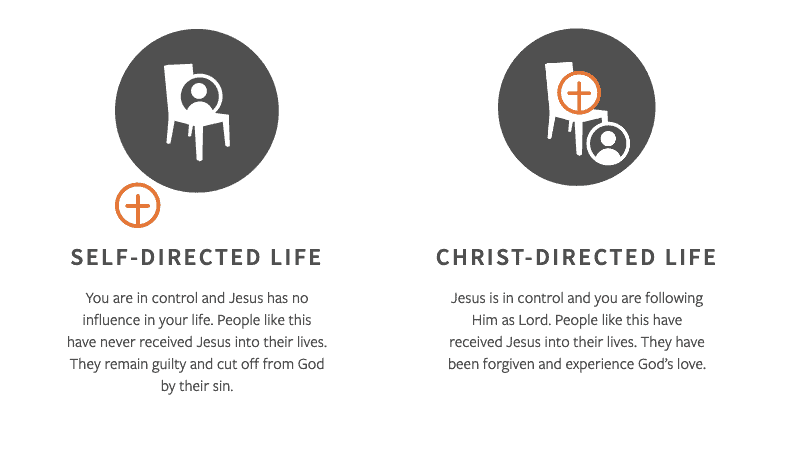
Just after the fourth point, the presentation has two circles with chairs in them, symbolizing “the throne of your life.”  These circles are an excellent way to help the student wrestle with and clearly communicate where they are in their relationship with God.  It also gives them a clear next step–to ask you a question, bring up a doubt or fear they have, or turn to Christ in faith. While we always want to share the gospel at the first good opportunity and bring the person to a point of decision about Jesus, we never force the gospel. We simply invite people to respond to God’s radical love for them.

Once you are done with the gospel presentation, ask them if they would like to pray and accept the sacrifice of Jesus on their behalf and follow Him as Lord of their life. We simply bring them to a crossroads and invite them to respond. Whether they want to right then or not, make sure you get their phone number or social media and set up a follow-up appointment to help them take the next best step in their spiritual journey. Check out Thrive Studies for awesome follow-up material!

No Matter What, Show Them Love and Care

The gospel of Jesus is a message of love and acceptance for drowning people who need a life raft, and it can only be accepted by people who want to hear it. We are not in the business of pressuring people to pray a prayer or treating them in an unloving way if they are not interested. If someone is far from God and wants to stay there, the best thing you can do is pray for them and treat them lovingly. In the words of Jesus, “do to others as you would like them to do to you” (Luke 6:31 NLT).

Next Step

Take your next step in sharing your faith. If you're new at this, practice a gospel presentation with a friend. If you're ready for the real thing, text someone right now to see if you can meet with them. For help in turning the conversation to the gospel, Bridges to Gospel Conversations will help.

Bridges to Gospel Conversations


Evangelism
This article is part of the Evangelism Collection. Read the rest of these articles to get an even better understanding of how to share your faith with students.

RECENT POSTS

The Reach Your School Playbook
A simple, step-by-step guide to help students, and the adults who support them, start and grow a movement to reach their school.
Campus Ministry Toolkit: Skills and Tools to Reach your School
Simple skills and tools to help you start conversations, share your faith, and build a movement on your campus.
Ask a Coach – Tips from an Expert
Some of our favorite tips from our best coaches to help you take the next step in reaching your school.
The Reach Your School Playbook
   

You want to make a difference at your school. You care about your friends. You see the need. You’ve probably even thought, “Someone should do something.”

What if that someone is you?

The Reach Your School Playbook was created to help students take that step, and to give adults a simple way to support them along the way.

Made for Students, Helpful for Adults

This Playbook is designed first for students. It helps you take ownership, lead your friends, and build something that actually reaches your school.

At the same time, if you’re an adult, youth leader, parent, or volunteer, this gives you a clear way to come alongside students without taking over.

  • Students lead
  • Adults support
  • Everyone moves forward together

Why Most People Don’t Start

A lot of students never take the first step. Not because they don’t care, but because they feel stuck.

  • “Where do I even begin?”
  • “What if no one shows up?”
  • “How do I get others involved?”

Uncertainty can keep people from moving. This Playbook breaks that barrier. It gives you a clear path so you can stop overthinking and start doing.

What This Helps You Do

This isn’t just ideas sitting on a page. It’s a practical guide you can actually use right now.

With the Playbook, you can:

  • Start something meaningful, even if you’re on your own
  • Gather a few friends and build momentum
  • Share your faith in natural, real ways
  • Lead with confidence, even if you’ve never led before
  • Build something that lasts beyond you

You don’t have to have it all figured out. You just need a place to start.

Students can
change their school,
they just need a path.

A Simple Path to Follow

The Playbook walks you through five clear steps. Each one is simple, practical, and designed to help you take action.

  • DREAM: Start with a vision for your school and what God could do there
  • PRAY: Learn how to pray for your campus in real, meaningful ways
  • GO: Take action, gather a team, and begin reaching people
  • GROW: Build a group that develops leaders and multiplies
  • SEND: Help others step out and reach their friends too

You don’t have to guess what to do next. It’s right there in front of you.

Built to Be Used, Not Just Read

This isn’t a long manual you’ll never finish. It’s short. It’s simple. It’s designed to move you forward.

  • Easy to read
  • Clear next steps
  • Real examples
  • Space to think and act

You can go through it on your own, or walk through it with a couple of friends. Adults can use it to guide conversations and help students take ownership.

You Don’t Have to Do This Alone

Starting something can feel intimidating. But you’re not on your own. The Playbook connects you to tools, coaching, and a bigger movement of people who are doing the same thing. Take one step, and you’ll find support along the way.

Start Today

You don’t need a perfect plan. You just need a first step.

Next Step

Download the Playbook with the button above and walk through the first section this week with a friend!

Campus Ministry Toolkit: Skills and Tools to Reach your School

As you learn to reach your school, there are some key ministry skills that will make a big difference. These are things every Christian student can grow in and you don’t have to be perfect to get started. We also have some great tools to help you take your next step. With a little courage and the right resources, you’ll be amazed how God can use you in your school.

Starting Spiritual Conversations

Bringing up spiritual topics can be hard, but it’s one of the most important steps in reaching your friends. If no one starts the conversation, most students will never talk about their faith.

  • Solarium: A deck of picture cards to help you start conversations about life and God.

Sharing Your Testimony

Your story matters. Sharing what God has done in your life can open hearts and help others realize that faith is personal and real.

Sharing Your Faith

The gospel is powerful and your friends need to hear it. Learning how to clearly explain the message of Jesus is a huge step in making your faith your own and helping others follow Him. 

  • How to Share the Gospel (article): a step-by-step guide to help you share the gospel with a friend.
  • Connecting with God Booklet: A short, simple booklet you can read through with a friend to explain how they can know Christ.
  • The Four Wristband: A wearable tool with four simple symbols to help you talk about God’s love and how to receive Christ.
  • GodTools App: A free app with interactive ways to share your faith in different languages and styles.

“You don’t have to be perfect to start reaching your school.”

Following Up a New Believer

When someone accepts Christ, they need help knowing what to do next. Helping a new believer grow in their faith is one of the most rewarding things you can do.

Leading a Small Group

Small groups are a powerful way to build community and help students grow. If you can lead a good conversation, you can lead a small group.

  • Thrive Studies App: Includes dozens of studies on real-life topics and built-in leader training.

Campus Ministry Training

Reaching students on your campus is one of the most strategic ways to share your faith. Learning a few simple principles can help you start conversations, gather students, and take steps toward building a movement at your school.

  • Campus Training Videos – Short, practical videos to help you learn how to reach students on your high school campus. These eight trainings cover key topics like meeting students, starting conversations, sharing your faith, and taking simple steps to build a movement.

Other helpful tools


Next Step
Pick one tool and take a step this week to start a conversation or gather a few friends.
Ask a Coach – Tips from an Expert

Starting a ministry on your campus is an exciting step, but it can also raise a lot of questions. What should you do first? How do you find students who are interested? What if your group is small or things do not go the way you expected?

This is where a coach can help. A campus ministry coach is someone who has experience helping students and leaders start and grow ministries on high school campuses. They listen to what you are facing, help you think through wise next steps, and connect you with helpful tools and resources along the way.

Throughout the Reach Your School Playbook, you will see short insights from coaches who have spent years helping students reach their campuses. This page gathers more of those tips in one place so you can learn from their experience and keep moving forward.

Below are practical coaching tips from leaders who have walked this road before. As you read, look for what applies to your situation right now and take your next step. You can get your own coach by emailing us at coachingcenter@cru.org. We’d love to help.

Starting a ministry on your campus can feel overwhelming, but you do not have to figure it out alone.

Coaching Tips

  • Ask a few non-Christian friends how they would respond to your ideas, then process those same questions with Christian friends to sharpen your thinking.


  • Evangelism is the engine of your ministry, and helping students influence others is how you build future leaders.


  • You don’t have to figure this out alone, there are people with experience who would love to help you gather students and get the word out.


  • You have rights on campus, learn them, then live them out with confidence.


  • Many people are looking for something bigger than themselves, so give them a vision worth joining.


  • You may be walking past someone God is preparing, start a conversation and see what He does.


  • Pray Scripture, if God says it, you can pray it, and keep prayers short so more people can participate.


  • Invite a coach to join your team early, it will help you move faster and avoid common mistakes.


  • Use the tools available to you, there are helpful resources for sponsors, leaders, and teams if you ask.


  • When meeting with school leaders, bring others with you so it’s clear you’re building something together.


  • Be curious, kind, helpful, and bold, those four traits open doors.


  • Work with your school, not against it, staff can often help you more than you expect.


  • Teams help you reach more people, save time, and build momentum.


  • If your school allows non-curricular clubs, they must allow a Christian club too.


  • Use tools and visuals that help people remember and apply what they learn.


  • Create environments people actually want to be part of, whether on campus or off.


  • Use social media, simple graphics, and personal invites, everyone plays a role in getting the word out.


  • Have a clear process for identifying and developing student leaders.


  • Work within school expectations for roles, but organize your team in a way that actually helps you function.


  • Start outreach where you already have relationships, teams, clubs, and shared interests.


  • Use response cards or forms to follow up, gather feedback, and invite people into next steps.


  • If God is nudging you to take a step, go for it, but bring others with you.


  • Parents can be powerful allies, don’t be afraid to involve them.


  • Always have a next step ready so you can invite people while they’re still engaged.

Next Step

Do you have any questions for our coaches? If so, ask your question here, or request a coach for your ministry by emailing us at coachingcenter@cru.org!

Contact Us

Share This Post

More to Explore