School Within a School
Discussion/Reflection Questions
  1. What in this video stands out to you? 
  2. What did you learn from this video? 
  3. What action can you take this week as a result of watching this video?

This article explains how to share about Cru with students using a tool we call “School Within a School”. 

Some key things to remember whenever you meet with students:

  • Pray.
  • Always be the adult.
  • Make sure you get to the point of your appointment.
  • Stay relational from start to finish.

Now with this in mind, let’s get to “School Within a School.” “School Within a School” is a simple tool that clearly explains what Cru is all about and gives students a picture of how they can get involved.
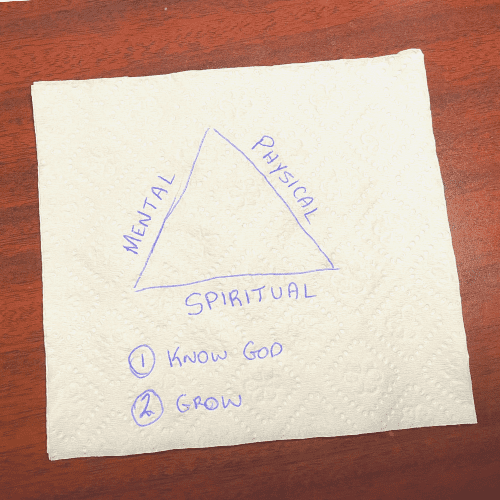
Let’s imagine that you’re sitting in a coffee shop with some students. After some initial casual conversation, say, “I’d love to tell you more about Cru and how you and your friends can get involved!”

Then you take out a piece of notebook paper or a napkin. Draw a roughly equilateral triangle to represent a person. Explain that we are all three-dimensional- body, mind, and spirit. Now write “Mental” on one side, “Physical” on the other, and “Spiritual” on the bottom.

"School Within a School" is a simple tool that clearly explains what Cru is all about and gives students a picture of how they can get involved.

ROKGvgd73YHOcbX4

Ask the question, “What does your school have to offer you in these three areas?” They will have answers for mental (class, tests, teachers) and physical (PE, sports, lunch?), but not for spiritual. Say, “This is where the high school ministry of Cru comes in! We exist to help students grow spiritually. What we mean by helping grow spiritually is two things…”

“First, we help students know God in a personal way through faith in Jesus Christ.” (Write the number 1 and “Know God.”)

“The second thing is grow in that relationship with Him.” (Write “Grow.”) Then ask the following key question: “Has anyone ever explained to you how to have a relationship with God?”

  • If they say, “No,” this is your chance to share the gospel with them. Say, “I have a little booklet (or app) that we use to explain that; may I share it with you?” If they are interested, share the gospel with them.
  • If they say, “Yes,” say, “That’s great, I’d love to hear more about your experience. How did you come to know God?” Listen to their story and then say, “Well, before you get involved in anything, you usually want to know what it’s about, I have a little booklet (or app) that we often use to share with people how they can have a relationship with God. May I share it with you?” Walking through the booklet gives you a chance to see how well they understand the gospel.

After you have a conversation about the gospel, go on to #2 “Grow.” Say, “Let me show you the things we offer to help you grow in a relationship with God.”

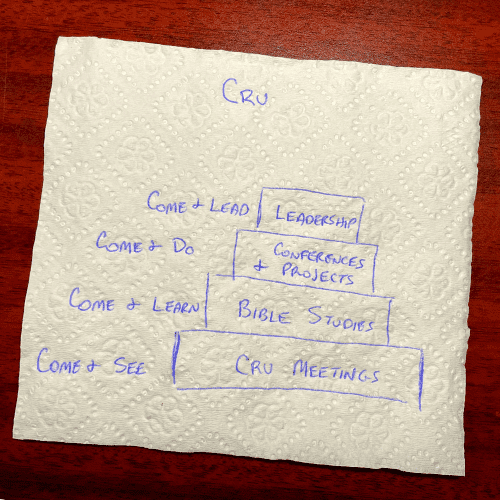
Draw the four layer birthday cake diagram below.
WCgjYgXclIxrSpSp

On the bottom layer, write “Cru Meetings.”

“This is the starting point, where students come and see what a relationship with God is about. These weekly or monthly meetings are often designed and led by students and are a fun way to hear about God and how He relates to you.”

“The next layer is ‘Bible Studies,’ where students come and learn. These events are a chance for you to be with your friends, talk about important aspects of your faith, and learn how it all relates to your life.”

“After that is ‘Conferences and Mission Trips.’ These are events that help you come and do. You get away from home for a few days or weeks to really grow spiritually. They are a place for you to trust God in new ways and have the chance to learn how to make a difference in your school.

“The last level is ‘Leadership.’ This is come and lead. Whether it’s leading friends in a Bible study or being upfront at a weekly meeting, or helping to serve behind the scenes, we want to encourage you to step up and take the lead.”

After you’ve gone through all of the layers, ask, “Which of these sounds most interesting to you?” Help them decide what their next best step is to get involved and help them get connected.

To sum all up, “School Within a School” is a great tool to explain Cru to students and show them where and how they can get involved.

Print off a School within a School PDF HERE

Next Step

Share the "School within a School" with a student new to your ministry or a student you'd like to invite to be involved. Make sure you know how to share the gospel because this great little tool will lead you there.

share the gospel

Next Step
Who are some students you work with that might make good leaders? Make a list of 5 students and begin praying that God would show you opportunities to help them step into leadership.

RECENT POSTS

Valentine’s Day Outreach

Valentine’s Day is a natural moment to invite students into something social, upbeat, and relational. This outreach works well in a home or school setting and is designed to feel more like a party than a program, while still clearly introducing students to your campus ministry and the gospel.

The key is intentional planning with a relaxed atmosphere. Music, refreshments, and friendly Christian students who are actively welcoming new people help set the tone from the moment students arrive.

Outreach Tips

  • Plan ahead. Set the date, confirm the location, and print fliers as early as possible.
  • Delegate. Give leadership roles to students and volunteers whenever you can.
  • Create an atmosphere. Keep things informal and upbeat with music and snacks. Encourage Christian students to seek out new faces.
  • Promote the event (optional). Leadership guys can hand out red roses or carnations to girls, or leadership girls can hand out chocolate kisses. Include a personal invitation the day before the outreach.
  • Obtain prizes. Especially for the Dating Game, nice prizes help boost energy and participation.

Sample Outreach Schedule

  • Mingling and refreshments
  • Welcome (3 minutes)
  • Campus ministry overview from the emcee (3 minutes)
  • Icebreaker: Famous Couples game (10 minutes)
  • Dating Game (20 to 30 minutes)
  • Student testimony with a relationship theme (4 minutes)
  • Relationship talk and gospel presentation (15 to 20 minutes max)
  • Comment cards (7 minutes)
  • Announcements (2 minutes)
  • Refreshments and hanging out (no set time)

The key is intentional planning with a relaxed atmosphere.

Game 1: Famous Couples

Choose an even number of participants and prepare a list of famous couples ahead of time, such as Luke Skywalker and Princess Leia or Romeo and Juliet. Write each name on a 3×5 card and as students enter, tape the name of one character on their back without letting them see it.

Each student may ask up to three yes or no questions per person to figure out who they are. They must also take turns answering questions when asked. The goal is to discover their identity and find their matching partner as quickly as possible. Continue until everyone is matched.

Game 2: The Dating Game

If you don’t have a lot of couples for this game, you could call it the “Best Friend Test” and have them do best friends instead. However, considering this party is about romantic relationships it is obviously better to have romantic couples playing.

This game is similar to the Best Friend Test you’ve probably seen on TikTok or shows like The Circle, or the old Newlywed game. (If you haven’t seen them, check them out). One person answers questions first, then their partner tries to guess what they said.

One partner leaves the room while the questions are asked. The partners in the room write the answers down. Then they come back, hear the same questions, and try to match their partner’s answers. Each correct match earns a point. The pair with the most points wins a prize.

The questions are light, funny, and all about how well you actually know the other person.

Dating Game Questions

For the girls (guys leave the room):

  • Which ice cream flavor best describes your relationship right now: Vanilla, Rocky Road, Peaches and Cream, or Tutti Frutti?
  • On your first date, which animal was he most like: Turtle, Kitten, Tiger, or Octopus?
  • How long have you been going out?
  • What is the most sentimental gift he has given you?

For the guys (girls leave the room):

  • Which Disney character would she say best describes you: Mickey Mouse, The Beast, Goofy, or Winnie the Pooh?
  • What song is “your song”?
  • What did you do on your first date?
  • What is her favorite perfume?
  • Which Valentine’s gift would she most like: candy, flowers, or a kiss?
  • What outfit is she wearing right now?

Optional non-gender questions

  • What is their go-to fast food order?
  • What song would they put on if they needed a hype boost?
  • What stresses them out faster than it should?
  • If they had a free day, how would they spend it?

What is something they are secretly really good at?

While relationships matter deeply to us, they also expose one of our biggest fears, the fear of not being truly loved.

Relationship Talk

Overview

The relationship talk should be short, clear, and serve as a natural bridge to the gospel. Valentine’s Day provides an easy entry point into the idea that everyone is searching for love and meaningful relationships, yet few of us have good models of what lasting love looks like.

This talk introduces the idea that there is a kind of love that lasts, a love that does not depend on performance or appearance, and that love is found in God.

Introduction

Begin with a funny or embarrassing dating story to lower defenses and help students relate.

The Talk

Relationships take a lot of time and energy, whether with parents, friends, coworkers, or romantic partners. While relationships matter deeply to us, they also expose one of our biggest fears, the fear of not being truly loved.

Psychologists often describe our greatest need as the need to love and be loved. At the same time, our greatest fear is that if people really knew us, they would reject us. Because of this, many of us wear masks and show only what we think others want to see.

Even people who care about us deeply can disappoint or reject us when we do not meet their expectations. That pain leaves us asking what real love actually looks like.

There are three common types of love people experience:

  • “I love you if…” love, which is conditional on behavior.
  • “I love you because…” love, which is based on appearance, popularity, or performance.
  • “I love you, period.” love, which is unconditional and unchanging.

What we truly long for is the third kind of love.

One Who Loves No Matter What

That kind of love exists, and it comes from God. God loves people for who they are, not for how they perform or what they offer. He invites us into a real relationship with Him where His love is constant and secure.

From here, transition clearly into the gospel and explain how students can have a relationship with God and experience His unconditional love.

If you’re not sure how to share the gospel, learn how to HERE

Comment Cards

Use a comment card to collect name, address, phone number, school, and grade. Include simple response options for students who received Christ, want more information, or want to get involved with your campus ministry.

Next Step
Plan your Valentine’s Day outreach early and involve student leaders in every step so more students can experience authentic relationships and hear the gospel in a welcoming environment.
Partnering with Other Ministries to Reach Your Campus

Groups like Cru, Young Life, and FCA each have their own strengths and strategies. Students connect with them for different reasons—it’s not “one size fits all.” We love and respect every group that’s helping students know Jesus. We’re on the same team, not in competition.

Here are a few ministries we often serve alongside:

  • Fellowship of Christian Athletes (FCA) – Students gather in “huddles” led by coaches, giving athletes a chance to live out their faith through the sports they love.
  • Young Life – Leaders invest deeply in relationships, earning the right to be heard before sharing the gospel.
  • Church Youth Groups – Churches are a vital part of every community. Many youth leaders volunteer at schools or visit during lunch to connect with students. Cru isn’t a church—we partner with local churches to help students get plugged in.
  • Christian Clubs – Many campuses have Christian Clubs focused on prayer, fellowship, and Bible study. They’re often inward-facing rather than outreach-focused.

Cru’s Approach

We share Christ as soon as we have the chance, then build a network of small group Bible studies. We train students to share their faith—through group outreaches, personal conversations, and larger gatherings.

Why This Matters on Your Campus

When you are starting or growing a ministry, ask, “Who is already here?” Sometimes a group has been serving for years. Sometimes no one is reaching that school yet. Often there is room for more than one group to thrive because no single ministry connects with every student.

If another group is already present, the best move is to connect. Grab coffee with their leader, ask questions, learn what has been working, and listen for their challenges. Your posture matters. Come in as an ally, not a rival.

“We’re not in competition; we’re on the same team.”

Stepping Onto a Campus With Other Ministries

If you launch Cru where another ministry exists, remember these things:

  • Speak well of them in front of students.
  • Avoid scheduling conflicts when possible.
  • Focus on students they are not already reaching.
  • Be willing to partner for events or outreaches.

The goal is not to win students to your ministry. The goal is to help them grow in Jesus.

How to Start the Conversation

Approaching another leader can feel awkward. Keep it simple:

  • Ask how their group is doing at that school.
  • Learn which students they connect with best.
  • Share your heart for students and where Cru could help.
  • Look for ways to collaborate rather than compete.

You may be surprised how often these conversations lead to friendship and partnership.

A Simple Way to Explain Cru

When someone asks what Cru is about, you can say:

Cru is a network of student disciples who see their school as a mission field. We help students grow in their faith through small groups, training conferences, and mission opportunities locally and around the world.

When it comes down to it, no single ministry can reach every student—but together, we can make a much greater impact. Each group brings unique strengths, connections, and opportunities to the table. By cheering each other on, looking for ways to partner, and sharing a heart for teenagers to know and follow Jesus, we multiply our effectiveness. When ministries work side by side instead of in separate lanes, schools see more of Christ’s love, more students hear the gospel, and more lives are transformed for eternity.

Next Step
Reach out to a local campus ministry leader this week and start a conversation about partnering together.
Sydney’s Story

From Grief to Purpose: Finding God in the Storm

Growing up in a Christian home, she always knew about Jesus, but her relationship with Him didn’t feel personal until tragedy struck in eighth grade. Transitioning from homeschooling to public school had already pushed her out of her comfort zone, and anxiety loomed as she struggled to find her place. Then, during the fall of 2020, both her parents contracted COVID. While her mom recovered, her dad’s condition worsened, leading to months of uncertainty. She vividly remembers the day he left for the hospital and the long, heartbreaking journey that followed. Despite moments of hope, her dad passed away on February 20th, 2021. At just 13 years old, she faced the devastating reality of losing her father—a loss that shook her world and her faith.

In the midst of that grief, she began to see God’s hand at work. During sleepless nights and moments of overwhelming sorrow, God surrounded her with people who cared—friends, family, and a community that embodied His love. Though the pain of loss didn’t disappear, she found comfort in the truth that this life is not the end. Inspired by Paul’s words about eternity, she started to see her father’s passing as a reminder of the hope we have in Christ. That hope spurred her to action. On a family mission trip to Thailand, she met students leading Cru groups at their schools, and the seed was planted to start something similar back home. Despite initial uncertainty, God provided resources, opened doors, and brought others alongside her to launch Cru at her school—a ministry that has been thriving for nearly a year now.

"Anxiety loomed as she struggled to find her place."

Her story is one of resilience, faith, and transformation. Through unimaginable grief, she discovered the depth of God’s love and the strength found in trusting Him. The loss of her dad deepened her desire to share Jesus with others, knowing firsthand how essential His presence is in life’s hardest moments. Cru has given her a platform to do just that—to tell others about the God who redeems brokenness and uses ordinary people to do extraordinary things. Her journey reminds us that while pain is inevitable, God is sovereign, faithful, and able to bring beauty from ashes.

Next Step

Check out Christina's Story and consider how God might use an international mission in your or another student's life.

christina's story

Share This Post

More to Explore